The author is a journalist from Kayin State who received support from The Kite Tales to write these diaries.
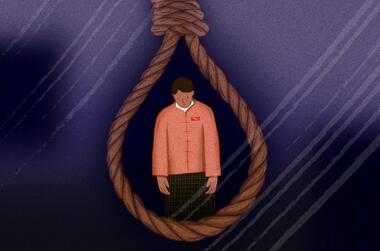
Aung Aung (not his real name) is the son of a government employee who dared to defy the 2021 military coup. The father became a fugitive, and so did the son, who had to drop out of Grade 7 at only 13 years old. But he never abandoned the pursuit of his education, following an alternative path to become an intern journalist, working part-time for a news outlet editing, producing, and managing online responsibilities.
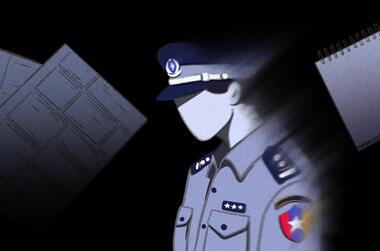
When the military began its ruthless hunt for civil servants who joined the civil disobedience movement (CDM) soon after the coup, Aung Aung and his family were forced to abandon their government housing. They sought refuge near the Thai border, in the Lay Kay Kaw area, under control of Myanmar’s oldest ethnic armed group, the Karen National Union.
Those who joined the CDM had to give up everything: their possessions, their livelihoods, their incomes. Even the children had to make sacrifices. Like so many other CDM households that fled to the jungles and mountains, Aung Aung had to give up his education and his social life.
I first met Aung Aung and his father in March 2021. They were at a temporary camp near enough to the Thai border that they could access the internet there. I was reporting on the lives of CDM participants sheltering in liberated territory under the KNU. I asked Aung Aung about continuing his studies and he told me he desperately wanted to resume his education.
“My friends are going back to school,” he said. Immediately following the coup, schools were closed due to general instability and understaffing, coupled with a students’ strike, but gradually over time classes resumed in some areas. Children of wanted dissidents like Aung Aung could only watch on in envy.
I helped resettle some of these CDM families to a safer haven, a new city in the Lay Kay Kaw area. Within that group of evacuees were journalists who had fled after reporting on the protests, and a cluster of computer-savvy young CDM staff from a government department. We arranged for them to teach seven CDM children, including Aung Aung, basic computer skills and fundamental journalism.
This was Aung Aung’s first real step on a new path. After just two months of learning, their small group had grasped the basics of computer typing, spreadsheets, Photoshop, and video editing. They even started creating their own amateur videos and short news pieces about their daily lives. And, remarkably, they began to assist with office work for the Lay Kay Kaw temporary CDM shelter.
“At night, we’d play games,” he recalled. “In the mornings, we’d clean our dormitories, eat breakfast, and then go help out with the work at the Lay Kay Kaw office.”
But then, in December 2021, the military laid siege to Lay Kay Kaw town. His family and friends found themselves trapped, forced to hide amidst the fierce fighting.
“Of course, I was scared,” he shared. “It wasn't just hearing the heavy artillery shells explode, which were deafening, but even the ground would shake. We had to lie flat under the bullets.”
He recounted how his fear intensified when a heavy shell struck the dining hall of the pro-democracy People’s Defence Forces, near his hiding spot. He saw splinters of wood and corrugated iron flying through the air as well as fires burning.
“There were so many other people around us, lying flat, just like us. Ants bit our faces from the earth; insects stung; it hurt, but we didn’t dare make a sound. The military were firing continuously, so we were terrified.”
When the sounds of battle finally subsided, at around 8pm, KNU-led forces escorted Aung Aung and his group to the headman’s house in a nearby village.
“About 80 people who were trapped in the fighting with us were freed.”
In the vast compound of the headman’s house, they were told to spread tarpaulins on the ground and sleep outside, or to huddle together on the floors inside the house. But Aung Aung, and indeed all the displaced, couldn't sleep. The relentless booms of artillery shells echoed through the night, and in their hearts, everyone simply prayed for the dawn to break quickly.
While his father provided support to the PDF troops on the battlefield, Aung Aung took on a leadership role among the community that had fled Lay Kay Kaw together. After about a week, as the fighting raged on and the military began deploying air strikes, they had to move again, fleeing once more to the banks of the river that forms the border between Myanmar and Thailand.
Eventually, when the battle intensified even further, they were forced to cross into Thailand.
Upon reaching Mae Sot, civil society organisations assisting refugees offered shelter to them. When they enquired about further education for the youths in the group, including Aung Aung, the youths expressed a desire to learn vocational skills and start working.
Aung Aung had by then been bitten by the journalism bug and received further training. He discovered he preferred the rhythm of video editing, crafting radio programmes, and capturing interviews with a camera more than chasing or writing articles.
Three years later, in 2024, Aung Aung found work at a small online news outlet where a collective of young people were producing and broadcasting news. He earned 6,000 Thai Baht a month (about $183). Many of the other students from Lay Kay Kaw, who studied alongside him, also found part-time work in the media industry.
“I want to attend a media school or university in Bangkok or Chiang Mai,” Aung Aung shared. He's also learning English, dreaming of the day he can return home, bringing his journalism skills with him.
In these times, a new generation of journalists is desperately needed. And seeing young people like this - who can earn a living while also contributing to the country's transformation through their craft - fills me with immense joy and pride.
Since the 2021 coup, the crises in Myanmar have disrupted the future for our youth, to the point where it feels increasingly challenging just to have simple opportunities to learn or to find work. Yet, it fills me with awe and profound respect when I witness Myanmar's youth break through these countless obstacles and somehow find a way to thrive.
(Editor’s Note: We are unsure if Aung Aung and his friends have been able to continue their work given the dramatic funding cuts to journalism over the past 18 months.)
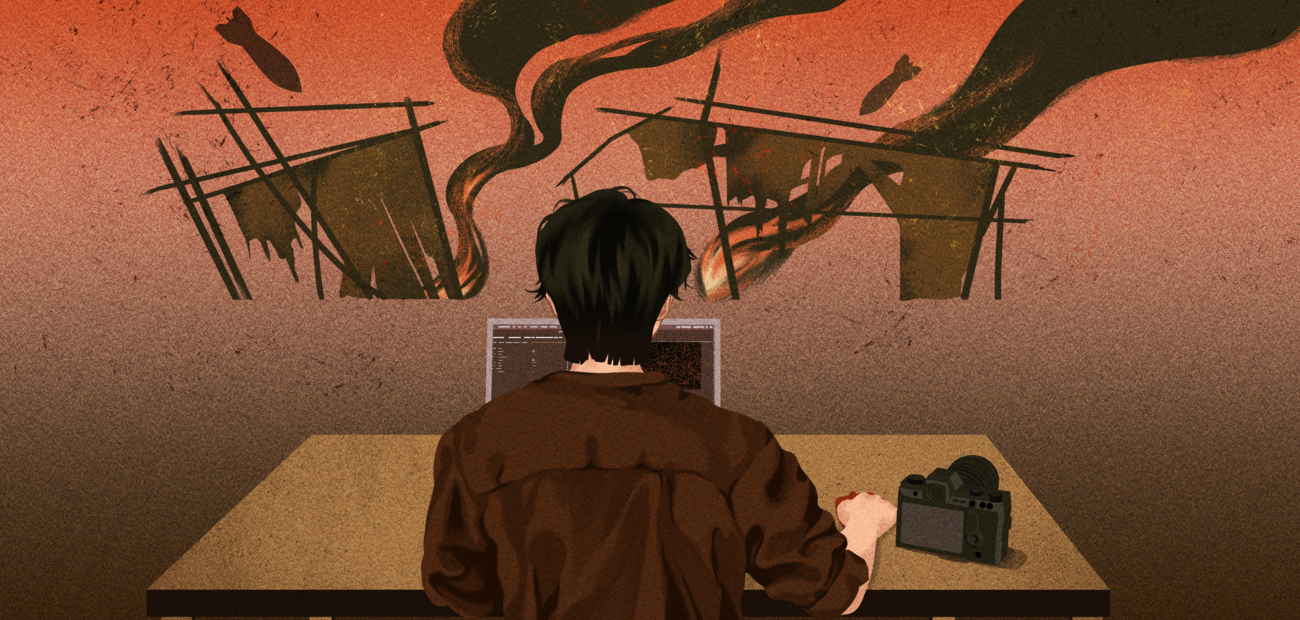
The artwork is by Songbird who is receiving support from The Kite Tales to produce illustrations.