The author is a journalist from Yangon who was jailed for reporting on the military’s abuses after the 2021. They received support from The Kite Tales to write these diaries.
Reflecting on Myanmar’s political history, it appears to me that the month of July has frequently been a time of sorrow and loss.
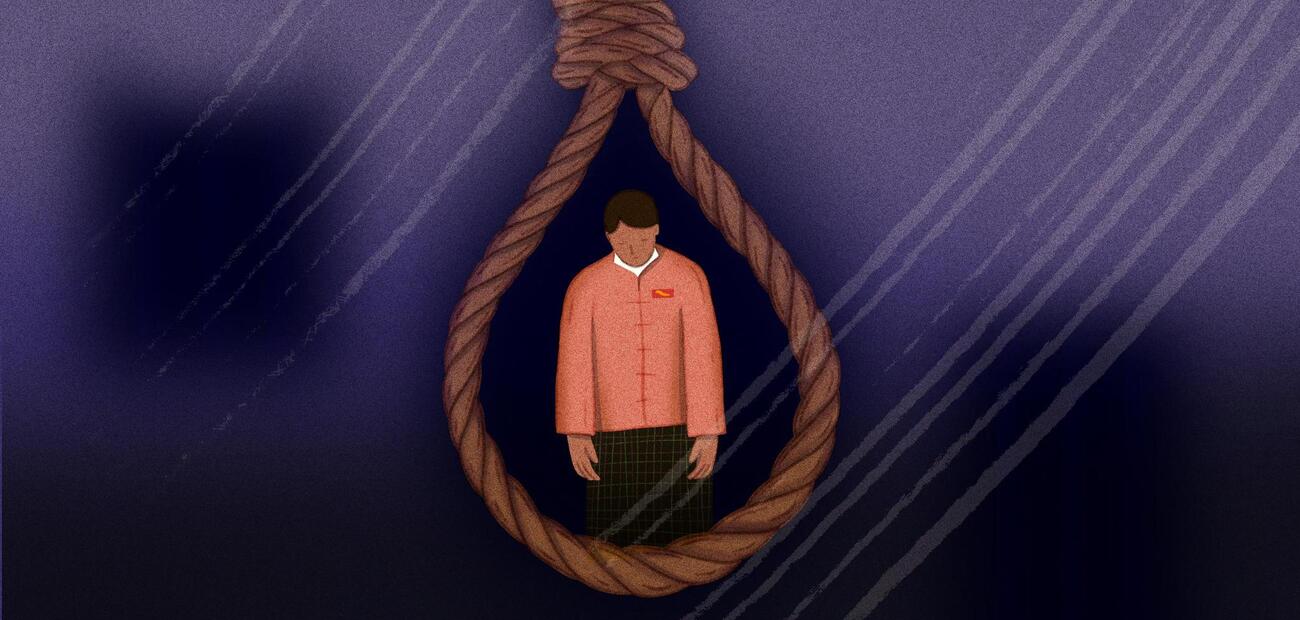
July 19, 1947 arguably set in motion the political crisis that continues to reverberate in bloodshed today, when Prime Minister Aung San and seven members of his cabinet were martyred in a political assassination. Another tragedy unfolded on July 7 in 1962, when hundreds of Rangoon University students were slaughtered on campus while protesting Myanmar’s first military coup. More recently, the current military regime executed four political prisoners on July 23, 2022, despite strong condemnation from the international community. The victims included two beloved pro-democracy figures: activist Ko Jimmy and elected parliamentarian Phyo Zeya Thaw, both accused of organising armed resistance against the military dictatorship.
On that infamous day, I too was confined within the walls of Insein Prison, where the hangings took place. (Editor: The weeks leading up to the executions were eerie and tense with anticipation. While the military has a track record of brutal violence, including extrajudicial killings, it hadn’t officially used capital punishment in decades, and was prone to psychological warfare. So when the regime announced in June it would hang four prisoners, many wondered if it would really follow through.)
Days before the executions, rumours started filtering to us from the male prison ward, claiming staffers were at work in the gallows, repairing equipment and bolstering security. Months later, after my release, I spoke with other former inmates, trying to piece together a clearer picture, as events took on greater importance with the benefit of hindsight.
“The gallows were right near our ward,” said a former political prisoner who was held in the extended block in the men's ward. “If you climbed to the upper floor and looked out through the iron bars, you could see it clearly.”
He recalled that in early July, the Minister of Home Affairs Soe Htut came to visit the extended block. Soon after, vinyl sheets went up, blocking the view.
“Even before the 23rd, prison staff were ordered into standby. This is when they’re in full uniform, alert, and ready. They began watching us closely. The prisoner leaders were called for meetings again and again. If more than two or three prisoners were seen talking together, we’d be summoned to the dorm office and warned. Sometimes, they even resorted to intimidation,” he said.
The night of July 22 was particularly strange. In the evening, we were forced to sit for three rounds of headcounts, under the pretext that there were discrepancies in the list of people who had to appear in court . I clearly remember the female prison staff, in full uniform, rushing about in a frantic frenzy.
Then the lights went off.
But let me first explain how electricity normally functions inside Insein Prison. Since I was first interned there in late 2021, power outages were frequent, both during the day and at night. However, whenever the electricity went out at night, generators were quick to hum to life, lighting up the cell blocks and dormitories. I had also noticed that the power cuts rarely lasted longer than an hour. It seemed that regime authorities made a point of ensuring the electricity wouldn’t be out for long, to prevent unwanted incidents like jailbreaks or riots.
All dormitories and cell blocks had designated inmates - known as tansees and baryas - prisoners, especially those with long sentences, who had been appointed to assist with daily operations. During blackouts, they were responsible for continuously 'calling guard'.
This involved each cell’s designated inmate taking turns loudly announcing something like: “Dormitory (--), Room (--), all inmates (how many) are present and well, sir!”
They had to do this one by one, room by room, without missing a beat, and in a voice loud enough for the on-duty prison staff to hear them clearly. At times like these, the prison guards and officers on rotation didn’t rest either, patrolling the dormitories and carefully inspecting their surroundings. Beyond the dormitory walls more security staff monitored the prison’s perimeter from the watchtowers. From there, they shone powerful spotlights across the compound, ensuring visibility remained uninterrupted during the blackouts.
In a tightly run place like Insein, where everything usually follows a strict routine, what happened on the night before the executions stood out as unusual. Starting around midnight, the electricity suddenly went out and didn’t return for four hours. The entire time, power was completely cut off. No whir of generators masked the continuous, unbroken guard calls echoing from every dormitory.
My dormitory was a two-storey building, and from my room on the second floor, it was possible to peer through the metal bars in the bathroom to the rooftops of other dormitories. Beyond that, we had a line of sight to the building by the main gate of Insein Prison, as well as the central watchtower inside the prison compound.
That morning, I briefly woke up at around 2:30 a.m. peeking through those bathroom bars. All the rooms were still in total darkness, except for the faint glow of a single tiny rechargeable bulb in each cell. I could still hear the steady chorus of guard calls from the dormitories. Then I noticed the central road near the front gate, where the main watchtower stands, was lit up with headlights. Vehicles were clearly moving, engines murmuring as tires squealed on the tarmac.
Strangely, the spotlight beams that normally circled the prison compound were nowhere to be seen. The night was a long and restless one: for the prison staff, for the tansees and baryas in the dormitories, and certainly for me too. I distinctly remember a quiet, dark, and heavy atmosphere that felt out of the ordinary.
When confirmation of the executions reached us two days later, grief swept across our ward of female political prisoners. Many of us cried, some quietly, others without holding back. In the days that followed, we tried to make sense of what had happened, and find ways to express our sorrow. We took apart the ear loops from our disposable facemasks and twisted them into white mourning bands. Those who were summoned to court wore them in their hair. Some of us dressed in black for a full week, a quiet protest wrapped in fabric.
In keeping with Buddhist customs, others chose to mark the seventh day. They collected packets of noodles, snacks, and whatever little fresh food we had, offering them as alms. Each group found its own way - rooted in belief, principle, or memory - to mourn. We later heard that women in the main compound were doing the same: praying, sharing Buddhist teachings, and keeping vigil throughout the week.
One thing we all agreed on was a boycott. None of us would buy from the prison's commissary, the small shop run by the prison authorities. It was a small act, but one of the few things we could control.
The execution of Ko Jimmy and the others was a profound loss, a wound torn into the heart of everyone who longed for democracy. Within the very walls of Insein, nearly every ward found its own way to protest. After my release, I heard political prisoners across Myanmar observed the one year anniversary of the killings with more quiet acts of defiance.
It is now more than four years since that chilling judgement, when Ko Jimmy, Ko Phyo Zeyar Thaw, and two other martyrs were taken from us. And I’m certain that this year, too, the political prisoners held captive in various facilities will stand in solidarity with the democracy-loving people of Myanmar, in a collective vow honoring the legacy and sacrifice of Ko Jimmy, Phyo Zeyar Thaw and all other martyrs.
The artwork is by JC who is receiving support from The Kite Tales to produce illustrations.