The author is a journalist from Shan State. They received support from The Kite Tales to write these diaries.
Time: A summer day in 2021.
Location: A town in Shan State.
“We don’t want military dictatorship!"
A crowd had gathered at a crossroads in town to demonstrate against the military coup, joined by journalists, photographers, and curious onlookers, all pressed together.
As I got there, the mood took on a chaotic urgency. People began to surge forward.
"Hey, disperse! Disperse! You'll go too far! Don't do anything!" shouts of warning pierced through the clamour.
A CCTV camera peered over the rally from its perch on a traffic island, little more than a small patch of tender grass and flowers. Suddenly its gaze was shrouded by a piece of cloth flung by unseen hands. Then, a young man scaled the pole, snatched a spray can from another youth waiting below and with a swift movement, pulled away the cloth and unleashed a burst of spray paint onto the lens. After that, he tugged out what appeared to be the camera's memory card and jumped back down.
"Let's disperse! Go back to your homes now. We'll meet again tomorrow!" A young voice called out from within the throngs. Some began to turn away, melting into the streets.
But another voice, that I assumed to be one of the protest leaders, called out to the reporters: "Come, you journalists, follow us! We need to document this. It's better if the others don't come."
They had seized a suspected informant in his 40s. He was led into a narrow alley. We journalists sprinted after them, our cameras clicking, capturing every hurried step. As they plunged into yet another alley, we discovered it was a cul-de-sac.
"Dead end! This way is blocked. We can't get out. Turn back quickly! Soldiers and police are coming behind us!" A young person from the group screamed. In an instant, we all spun around, running back the way we had come.
As we reached a small incline, military trucks and police cars suddenly roared into the road directly ahead. Some people darted into a telecoms office on one side of the road. The suspected informant was swept along with them. We pushed deeper into the back of the house. Others plunged into a house on the opposite side.
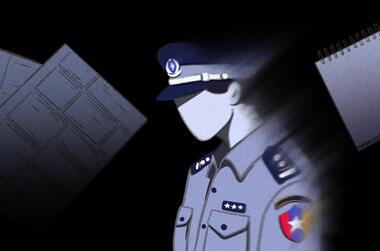
He was a Shan man from a nearby town and a police officer. He claimed he had to send a full report, with details of the protest location, gathering points, and crowd numbers, all within an hour. He said his team, including himself, numbered at least 7 to 12, and many such teams had been sent out across the city.
As the interrogation continued, a helicopter began to circle directly above us. It was then that the group switched off and removed the battery from the walkie-talkie he carried. To make him easily recognisable the group proceeded to shave off his eyebrows.
The protesters said they planned to take him back to his place. And soon after, a car pulled up on the street in front of the house, ready to take him away. But we couldn't exit through the front door anymore.
The surrounding streets were now choked with military vehicles, forming a tight cordon. If their man emerged from inside, the soldiers would know our location and come after us. So, we frantically searched for another way out of the compound.
Two other journalists and I peered out from a window, wondering if we could slip away. Outside, soldiers and police swarmed. If we left, they would know the protesting youth were inside, and they might storm in, violently arresting everyone. So, we decided against leaving, choosing instead to follow the lead of the protest organisers.
There was a church compound next to the house we were in, separated only by a narrow ditch. We leapt across and found a small preschool building with three or four rooms.
About ten of us, including the youth, desperately searched for an exit. We entered the home of a family living within the church compound and asked them for an escape route.
The homeowner pointed to a gate: "You can exit quietly, one by one, through this gate. Just don't all rush out at once."
One of the young people suggested that we split up and hide in different houses within the church compound. So, the three of us journalists, along with three or four other young people, slipped into one of the houses.
The homeowners offered us water. They turned on the TV, playing music. They even made us quince juice, urging us to stay calm, to keep our minds quiet. They told us to wait, to watch the situation, and only leave when it was truly safe.
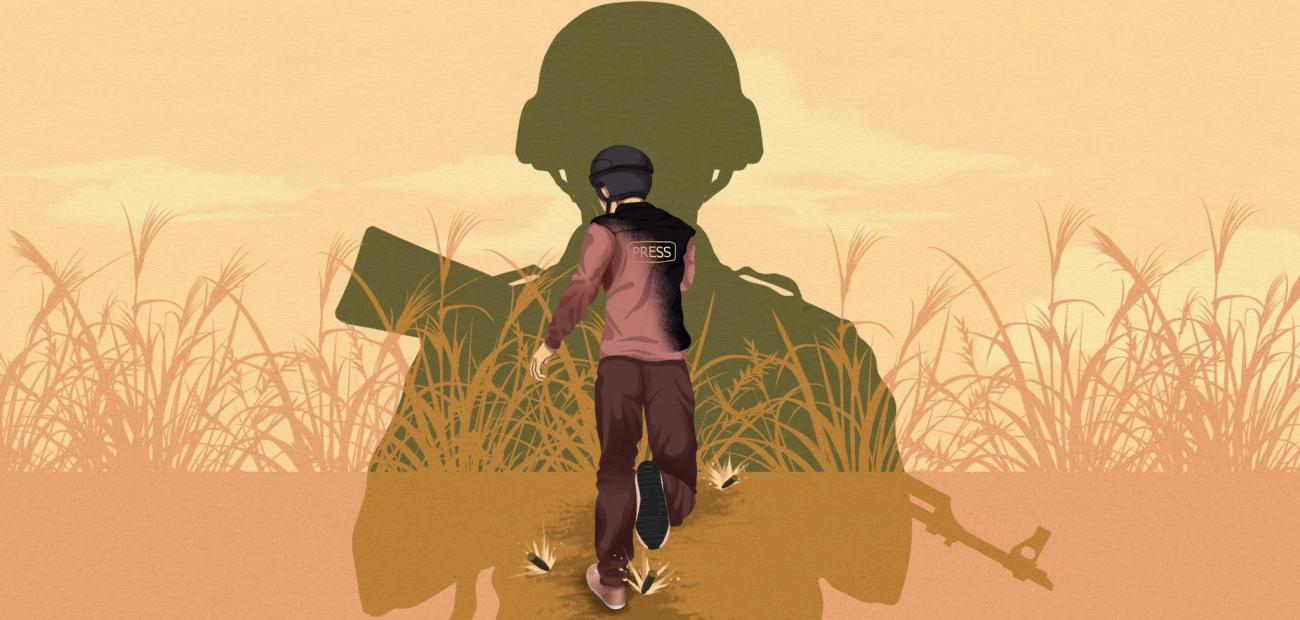
I, meanwhile, took off my vest, the one with "Press" emblazoned on it, rolling it into a ball and hiding it under the bed in the bedroom. I clutched my motorcycle helmet. As we sat there, the sound of gunfire erupted. "They're raiding and shooting near the top part of the church! They're coming down towards the preschool!" a young person whispered.
We prepared to exit through the small gate at the back of the house. Moments later, both police and soldiers were near the preschool within the church grounds. They were still firing their guns.
It seemed the informant had been rescued and some of the young protesters had been arrested. Apparently, a girl who had been watching the informant took a photo and posted it on Facebook, revealing their location, according to the protesters with us.
A short while later, soldiers turned their guns towards us and started firing. We couldn't stay in that house any longer. One by one, we slipped out through the back door. Police and soldiers were still in close pursuit. Once everyone was out, we quickly closed the gate and moved along the footpath.
Behind us, soldiers and police fired their guns, chasing us. Bullets landed near my heels. "This is it," I thought, and ran.
The path was rarely used and overgrown. Dogs barked, adding to the cacophony. And behind us, the soldiers and police were still running, gaining on us. They were almost upon us. Seeing some houses, we split up and ducked inside.
The family in the house we entered was having dinner. There were four of us. The homeowner, a man, quickly instructed us, "Take off your upper clothes. Put your motorcycle helmets and everything in bags. Quickly wash your hands and feet and start eating with us."
The homeowner closed the compound gate and went to check the situation outside. We sat down, trying to blend in, pretending to eat. While we were eating, the police and soldiers who had been chasing us passed our house, checking houses nearby.
After eating, we moved to the living room. I think about an hour passed. The homeowner shared that he was also involved in organising the protests. "Good thing we didn't accidentally enter an informant's house; that would have been real trouble," we murmured to each other.
After quite a while, the homeowner went outside to check the situation again. "It's clear now. You can come out. No one's there," he reported. With that, we decided to head back to town.
We didn't have our motorcycles. And at the end of the road we would take, soldiers and police were still waiting. Our phones and cameras were filled with photos. Finally, we called a senior journalist from a major news agency to pick us up with two motorcycles.
We waited outside the house compound. When the motorcycles arrived, the three of us journalists prepared to ride with them. Just then, about three of the young people who had interrogated the informant came by, heading to town from their hiding spot. They saw us, stopped their motorcycles, and said, "Do you want to take this walkie-talkie we confiscated from the informant? We can't carry it."
We couldn't take it either. So, we told them to dismantle it and discard it. Then, we rode into town on the motorcycles. We couldn't retrieve our own motorcycles yet. So, we went to a tea shop in the park.
After a while, we went to the church to interview eyewitnesses and ask what just happened.
After conducting interviews, taking photos, and finally retrieving our motorcycles, we returned to our own homes, our hearts heavy, and uploaded the news we had gathered from the interviews. I had forgotten my press vest at the house in the church compound. I didn't dare go back for it just yet, but I was also consumed by worry that the homeowners might be interrogated because of my vest.
It was three or four days later that I managed to retrieve my press vest. The homeowner told me no one had come to question them. Only then could I truly breathe a sigh of relief.
The artwork is by Songbird who is receiving support from The Kite Tales to produce illustrations.